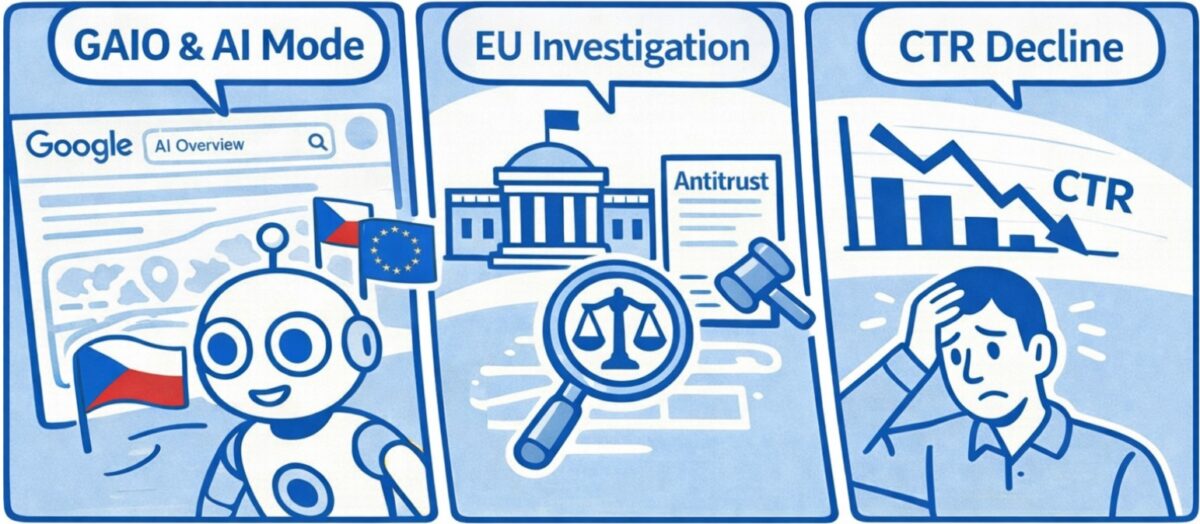
We have more data since the last review (November 2025). Google AI Overviews (GAIO) and AI Mode have expanded, the EU has launched a formal antitrust investigation, and new studies show a significant drop in CTR for some queries.
In short, this is a continuation of the article ” Google AI Overviews and AI Mode: Top studies, analysis and recommendations (Update: 2025-06-22)” 🙂 for 2026.
Don’t expect a novel, but for me it’s more like a pile of sources with notes that I personally need to refer to when I talk to people 🙂
1. Studies and Research – Impact on CTR and Traffic
1.1 Ahrefs – AI Overviews Reduce Clicks by 58% (2026-02-04)
Why read this: An update of a key study with new data from December 2025 confirms that the GAIO impact is worsening – from a 34.5% decline in April 2025 to 58% in February 2026.
Key findings:
- GAIO reduces organic CTR for the first position by 58 %
- The impact decreases with position: position 1 (-58 %), position 5 (-32.6 %), position 10 (-19.4 %)
- Ahrefs also states that the trend fits into the broader growth of zero-click behavior
Methodology: 300,000 keywords (150,000 with GAIO, 150,000 without), aggregated Google Search Console data, comparison December 2023 vs. December 2025.
1.2 Seer Interactive – AIO Impact on Google CTR: September 2025 Update (2025-11-04)
Why read this: The most extensive study with long-term tracking – 15 months of data, 3,119 keywords, 25.1 million organic impressions.
Key findings:
- Organic CTR for queries with GAIO: decline from 1.76 % to 0.61 % (-61 %)
- Paid CTR for queries with GAIO: decline from 19.7 % to 6.34 % (-68 %)
- Even queries without GAIO show an organic CTR decline of about 41 % during the observed period
- Citation in GAIO = +35 % organic clicks, +91 % paid clicks compared to non-cited
Important: The study states that GAIO appears more often on queries that historically had lower CTR (similar to Featured Snippets).
1.3 Reuters Institute – News Publishers and AI Search (2026-01-12)
Why read this: An academic perspective on the future of publishers – a survey of 280 media executives from 51 countries.
Key findings:
- Publishers expect search traffic to decline by more than 40 % within 3 years (reported as aggregated expectation)
- About 20 % of respondents expect very high losses
- The report cites Chartbeat data on declining referral traffic from Google Search (globally and in the US)
- Utility/lifestyle content tends to be most affected, hard news may have different dynamics
(Also referenced in Search Engine Land: [https://searchengineland.com/news-publishers-search-referrals-drop-report-467408](https://searchengineland.com/news-publishers-search-referrals-drop-report-467408))
1.4 IDEAVA – 12 Studies Compilation (2026-02-08)
Why read this: A comprehensive overview of 12 studies, useful for a quick landscape summary.
Key findings:
- Authoritas: significant CTR decline for the top link when GAIO is present
- Pew Research: lower click-through rate to traditional results when AI summaries are present
- DMG Media: significant CTR losses for selected query types
- Semrush: growth in GAIO prevalence during 2025
- HubSpot case: significant organic traffic changes during the transition to AI-first SERPs
URL: https://ideava.com/insights/ai-overviews-ctr-decline/
1.5 iPullRank – Referral Patterns in AI Mode (2025-03-07)
Why read this: The first public data on AI Mode behavior.
Key findings:
- Only 4.5 % of sessions in AI Mode end with a click to an external website (vs. 24 % in traditional search)
Important clarification:
- Retention metrics such as “53 % users only once” and “~9 % active 5+ days” appear in follow-up iPullRank materials / secondary citations, not in this specific article.
URL: https://ipullrank.com/referral-patterns-ai-mode
1.6 Keypers – Google AI Mode in the Czech Republic (2025-11-19)
Why read this: A local source with a comprehensive overview of AI Mode data in the Czech Republic.
Key findings:
- AI Mode available in the Czech Republic since October 7, 2025 (with subsequent expansion)
- Top cited domains in AI Mode in the Czech Republic (according to cited local data): google.com, zbozi.cz, youtube.com, alza.cz, heureka.cz
- AI Mode uses Query Fan-Out
- Responses may draw from a high number of sources (reported as “up to 100” in the article)
URL: https://keypers.io/en/blog/google-ai-mode-in-the-czech-republic-a-new-chapter-in-search/
2. Regulatory Developments – EU Antitrust
2.1 European Commission – Formal Antitrust Investigation (2025-12-09)
Why read this: The first official EU step against Google in the context of using content for AI in search.
Key findings:
- The EC announced on December 9, 2025 the opening of a formal investigation
- It examines possible unfair conditions toward publishers and content creators
- The use of YouTube content for AI purposes is also under review
- Topics: publisher conditions, choice/opt-out, impact on competition
Primary source: https://ec.europa.eu/commission/presscorner/detail/en/ip_25_2964
2.2 European Publishers Council – Antitrust complaint (2026-02-10)
Why read this: A formal complaint by representatives of European publishers following the EC investigation.
Key findings:
- EPC filed a formal complaint on February 10, 2026
- Alleges violation of Article 102 TFEU
- Arguments: use of content without adequate consent/compensation, insufficient opt-out
- Call for a more transparent and fair licensing framework
2.3 Reuters – Google hit by European publishers’ complaint (2026-02-10)
Why read this: An independent news summary of the EPC complaint and Google’s response.
3. Practical Strategies and the Future
3.1 Searches Everywhere – Google AI Overviews in 2026 (2026-02-18)
Why read this: A strategic commentary on 2026 trends.
Source note: Primarily an expert blog perspective (not an academic study). Treat as a complement to data-driven studies.
3.2 Semrush – AI Search SEO Traffic Study (2025-07-21)
Why read this: A predictive model of AI search impacts on traffic and business value.
Key findings:
- An AI search visitor can be up to 4.4× more valuable than a standard organic user
- Prediction: AI search may grow faster for informational queries than for transactional ones
URL: https://www.semrush.com/blog/ai-search-seo-traffic-study/
Additional note (separate related Semrush study):
Metrics such as “92 % answers with sidebar”, “average 7 unique domains”, “51 % domain overlap / 32 % URL” belong to the AI Mode comparison study: [https://www.semrush.com/blog/ai-mode-comparison-study/](https://www.semrush.com/blog/ai-mode-comparison-study/)
3.3 Evergreen Media – Google AI Overviews: What’s Changing for SEO & SEA in 2025 (2026-02-06)
Why read this: A trend overview from the DACH market + compilation of data from multiple studies.
Key findings:
- GAIO often appears for informational queries
- GAIO sources are often from top results
- GAIO frequency varies by vertical
- The impact on SEO/SEA depends on the SERP mix and intent type
URL: https://www.evergreen.media/en/guide/google-ai-overviews/
3.4 The Digital Bloom – Most Cited Domains in Google AI Overviews 2025 (2025-11-01)
Why read this: A compilation of “who is most cited” in AI answers.
Source note: Secondary/commentary material, recommended to verify against primary data (Ahrefs, Semrush, Seer, etc.).
3.5 Andreessen Horowitz – The Top 100 Gen AI Consumer Apps – 6th Edition (2026-03-09)
Why read this: A strong market overview of which consumer AI products are actually reaching mainstream usage on web and mobile, with useful context for product strategy, distribution, and the changing shape of the AI market.
Source note: Primarily an investor / market landscape analysis, not an academic study. Best used as directional market intelligence and product-distribution context.
Key findings:
- The list expands beyond strictly AI-native products and now includes consumer apps where generative AI has become a core part of the experience, such as CapCut, Canva, Notion, Freepik, and Grammarly.
- The web ranking is based on unique monthly visits from SimilarWeb (January 2026), while the mobile ranking is based on monthly active users from Sensor Tower (January 2026).
- ChatGPT remains the leading consumer AI product, but the race to become the default AI assistant is intensifying, especially around ecosystem lock-in, connectors, and app platforms.
- AI adoption is geographically fragmented. In the article’s per-capita adoption index, Singapore ranks first, followed by the UAE, Hong Kong, and South Korea, while the United States ranks 20th.
- Among creative tools, usage is shifting from standalone image generators toward video, music, and voice products, while bundled AI features inside larger platforms continue to gain traction.
Methodology: Web products are ranked by unique monthly visits and mobile apps by monthly active users, both using January 2026 datasets. The article also adds interpretive sections on assistant competition, geographic adoption, creative tools, and agentic products.
Useful addition: The article includes direct link lists for the Top 50 Gen AI Consumer Web Products and the Top 50 Gen AI Consumer Mobile Apps, which makes it useful for fast competitive monitoring.
URL: https://a16z.com/100-gen-ai-apps-6/
4. Summary Table of Key Statistics
| Metric | Value | Source | Publication Date |
|---|---|---|---|
| CTR decline (position 1) | -58 % | Ahrefs | 2026-02-04 |
| Organic CTR with GAIO (observed period) | 0.61 % | Seer Interactive | 2025-11-04 |
| Organic CTR decline with GAIO | -61 % | Seer Interactive | 2025-11-04 |
| Paid CTR decline with GAIO | -68 % | Seer Interactive | 2025-11-04 |
| Expected search traffic decline (3 years) | >40 % (aggregated expectation) | Reuters Institute | 2026-01-12 |
| AI Mode clicks to external web | 4.5 % | iPullRank | 2025-03-07 |
| AI search visitor value | up to 4.4× | Semrush | 2025-07-21 |
5. Conclusion, Main Trends
- CTR in informational queries is under pressure – multiple studies confirm significant declines when AI elements are present.
- Intent and SERP type are critical – the impact is not uniform; brand and transactional queries behave differently than purely informational ones.
- Citations in AI answers are the new visibility battle – those cited may gain a relative advantage over non-cited competitors.
- EU regulatory pressure is increasing – the formal EC investigation + EPC complaint indicate legal and economic escalation of the topic.
- AI Mode is a separate chapter – a different UX model, different click behavior, and the need for separate measurement and strategy.
- Visit quality may increase even with lower volume – in some segments there is a visible shift from “more clicks” to “higher intent”.